
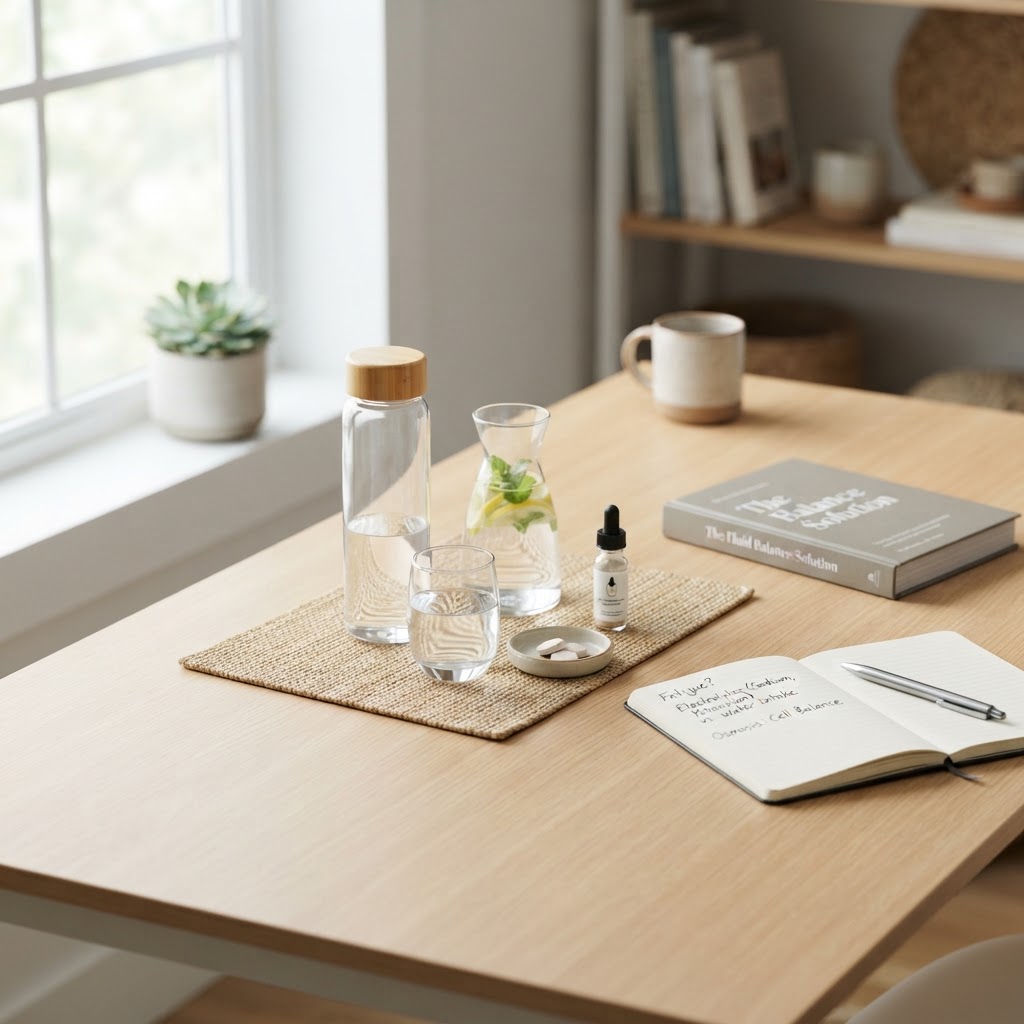
You are sitting at your desk, three hours into a deep-work session, and the familiar haze sets in. You reach for your water bottle, convinced that another glass will clear the fog. But an hour later, you are just as tired—and likely making more trips to the restroom. For many creators and desk-bound professionals, hydration has become a volume game. We track ounces and liters, assuming that more water equals better performance. However, if you are drinking plain water without considering the solute-solvent equilibrium, you are likely flushing fluids through your system faster than your cells can actually absorb them.
The Volume Trap: Why Pure Water Isn't Enough
Hydration is not merely about the presence of water; it is an electrical process. Your cells rely on osmosis—the movement of water across a semipermeable membrane—to maintain fluid balance. This process is governed by the concentration of solutes, primarily electrolytes like sodium and potassium, on either side of the cell wall [7]. When you consume large volumes of plain water, you risk diluting your blood sodium levels. This can lead to a state where your body struggles to retain the fluid you are drinking, effectively 'flushing' the water out before it can hydrate your brain or muscles [6].
True hydration happens at the cellular level—not simply in the stomach or bloodstream. Without the correct ionic balance, water intake outpaces the body's ability to retain it.
The Sodium-Glucose Transport Mechanism
To move water into your cells efficiently, your body uses a specific biological 'key' known as the sodium-glucose co-transporter (SGLT1) [2, 3]. This mechanism requires the presence of both sodium and glucose to pull water across the intestinal lining and into the bloodstream. By pairing your water intake with a balanced ratio of electrolytes, you facilitate this transport, ensuring that the fluid you consume is actually utilized for cellular function rather than immediate excretion [6].
The 1:1:1 Electrolyte-to-Volume Ratio
Instead of chasing a gallon-a-day goal, shift your focus to a 1:1:1 ratio. This framework helps you map your intake to ensure your electrolyte inputs match your fluid volume. While individual needs vary, the goal is to ensure that every significant intake of water is accompanied by a proportional amount of sodium, potassium, and magnesium [5, 6].
- Audit your current intake: Track your water volume against your electrolyte inputs for 48 hours.
- Pulse your intake: Instead of constant sipping, drink in 12-16oz blocks paired with a small electrolyte input.
- Monitor the 'flush' factor: If you are visiting the restroom more than once per hour, your electrolyte-to-water ratio is likely too low.
- Use the 1:1:1 rule: For every 16oz of water, ensure you are getting a balanced micro-dose of sodium and potassium to support osmotic pressure.
Worked Example: A 24-Hour Hydration Plan
For a desk worker, the goal is to avoid the 'afternoon crash' caused by electrolyte depletion. Start your morning with 16oz of water containing a pinch of sea salt and a squeeze of lemon (for potassium). At 11:00 AM, repeat this. During your 2:00 PM slump, instead of plain water, use an electrolyte-balanced drink to drive fluid into the cells. By evening, taper off your volume to prevent sleep disruption. This approach mirrors the principles found in our 21-Day Wellness Reset, focusing on systemic balance rather than arbitrary volume targets.
Important Limitations
This framework is a focus-optimization tool, not medical advice. If you have specific salt-sensitive conditions, kidney concerns, or are under the care of a physician for blood pressure management, you must bypass electrolyte adjustments and consult your healthcare provider before changing your intake. Always prioritize professional medical guidance over performance-based protocols.
