
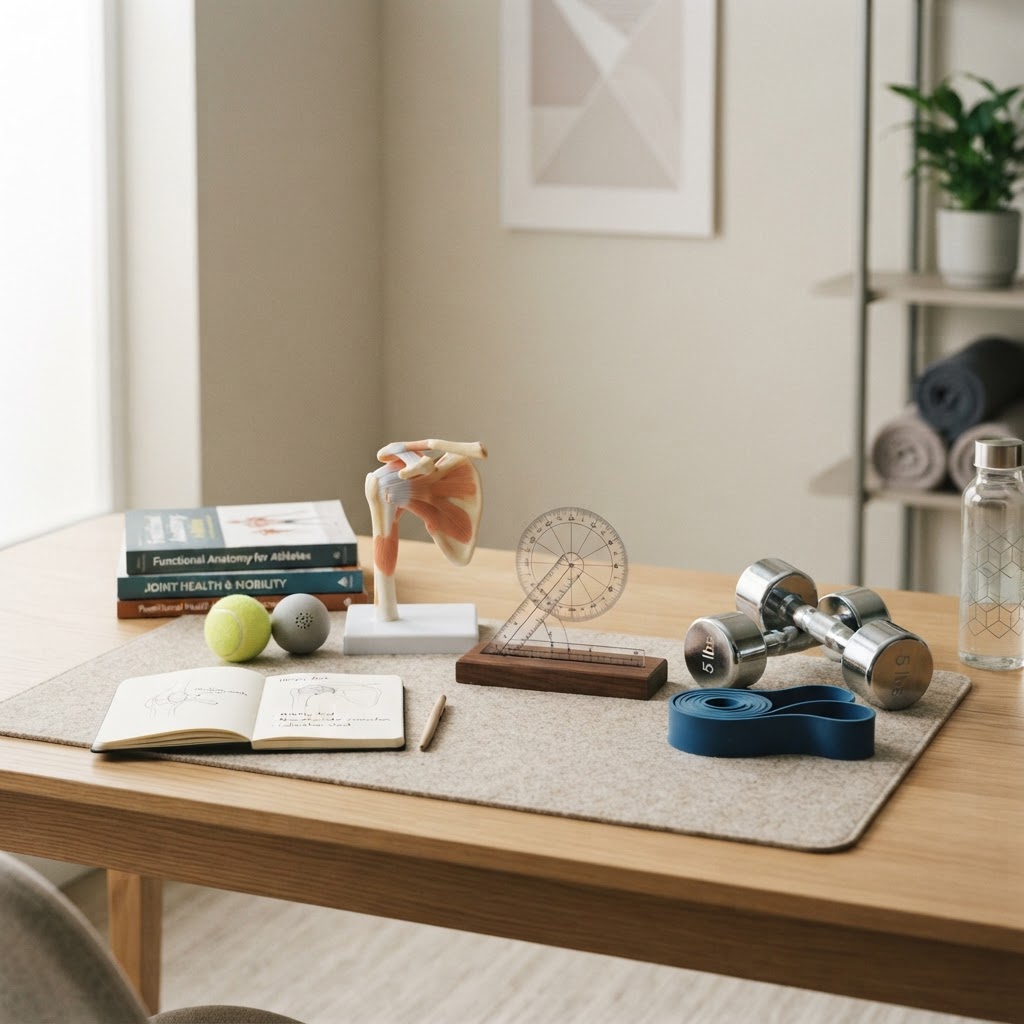
If you spend eight hours a day at a desk, your body is likely trapped in a state of structural compression. When you transition directly from a chair to a squat rack, you are asking your muscles to perform under load while your joints are still locked in a sedentary configuration. This is the 'Movement-Calibration Gap'—the disconnect between your desire to build strength and your body's current inability to move through a full, healthy range of motion.
The Structural Compression Reality
Prolonged sitting is not just 'rest'; it is a biomechanical stressor. Research indicates that sitting in a 90-degree hip flexion position keeps the psoas and iliacus muscles chronically shortened, which can pull the pelvis forward and increase lumbar facet joint compression [2]. When you stand up, your lower back is often already under tension, making standard gym movements like heavy squats or overhead presses potentially harmful if you haven't first 'unlocked' these compressed areas [2, 10].
The Joint vs. Muscle Fallacy
Traditional strength training often focuses on hypertrophy—increasing muscle volume—which is effective for building mass [7]. However, hypertrophy training does not inherently address the stiffness of connective tissue or the lack of articulation in joints [6]. You can have strong muscles that are effectively 'glued' to a restricted joint, leading to a false sense of fitness while your movement quality degrades. True performance requires creating space in the joint capsule before you apply resistance.
You cannot build a high-performance engine on a chassis that is rusted shut. Joint-prep is the process of restoring the structural integrity that your desk job systematically dismantles.
The 5-Minute Decompression Protocol
Before you pick up a weight, spend five minutes on this sequence to prime your body for movement. This is not a workout; it is a calibration tool.
- Hip-Capsule Rotation: Perform 10 controlled, slow circles per side while in a quadruped position to lubricate the hip joint.
- Thoracic Spinal Extension: Use a foam roller or a chair back to gently extend the mid-back, reversing the 'slouched' desk posture.
- Scapular Wall-Slides: Stand against a wall and slide your arms up and down to engage the muscles that stabilize your shoulders, counteracting rounded-shoulder tension.
Worked Example: Modifying Your Squat Session
Instead of walking into the gym and immediately loading a barbell, perform the hip-capsule rotation sequence first. By spending two minutes articulating the hip joint, you reduce the 'pinch' often felt at the bottom of a squat. This allows you to hit a deeper, more stable position without your lower back compensating for tight hip flexors. You aren't changing the lift; you are changing the state of the joint performing the lift.
Limitations and The Feedback Loop
It is important to recognize that this protocol is a maintenance and injury-prevention tool, not a substitute for progressive overload. You will not build significant muscle mass through decompression alone; you must still apply resistance to see strength gains [7]. Furthermore, consistency is the only way to see structural changes. Instead of tracking only the weight on the bar, track your 'articulation score'—how fluidly you can move through your warm-up without pain or restriction. When your joints move freely, your strength training becomes safer, more efficient, and significantly more sustainable over the long term.
