
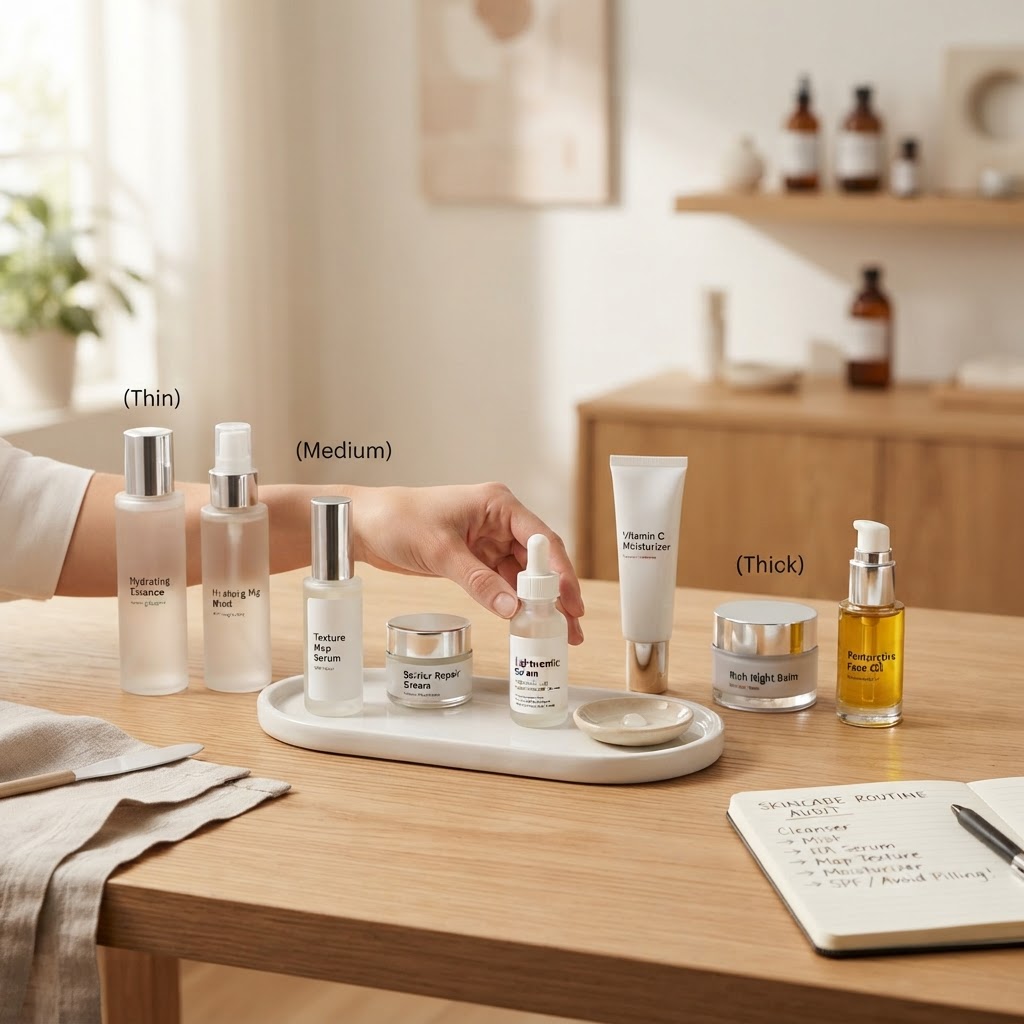
If you have ever finished your morning routine only to find tiny, rubbery granules rolling off your skin the moment you apply foundation, you have experienced pilling. Most consumers blame the product quality, but the culprit is rarely the formula itself. It is the physics of your application sequence. When you layer products based on marketing labels—like 'toner' or 'serum'—rather than their physical viscosity, you create a barrier that prevents active ingredients from reaching the stratum corneum.
The Science of Film Formation
Your skin is a biological barrier designed to keep things out. To deliver actives effectively, products must be able to penetrate this barrier. When you apply a thick, occlusive cream before a thin, water-based serum, you are essentially placing a plastic wrap over your skin. The serum cannot penetrate the lipid-heavy barrier of the cream, leaving it to sit on the surface where it eventually dries, clumps, and pills under the friction of your next step.
Pilling tells you that material is rolling or clumping on the surface. It does not tell you how much of an active ingredient reached the skin.
The Viscosity Gradient Chart
To stop the cycle of waste, categorize your shelf by physical state. Always move from the most fluid to the most solid to ensure each layer can anchor itself before the next is applied.
- Water-like: Toners, essences, and liquid exfoliants.
- Gel-based: Hydrating serums, often containing humectants like hyaluronic acid.
- Emulsion: Lightweight lotions and milky serums.
- Oil-based: Facial oils and oil-serum hybrids.
- Ointment/Occlusive: Heavy creams, balms, and SPF.
A Worked Example: The 60-Second Rule
Consider a routine involving a 15% Vitamin C serum (low viscosity), a Hyaluronic Acid gel (medium viscosity), and a Ceramide cream (emulsion). If you apply these in rapid succession, the polymers in the gel will likely clash with the silicone or oil base of the cream. Instead, apply the Vitamin C, wait 60 seconds for the carrier to dissipate, apply the Hyaluronic Acid, and wait another 60 seconds. This 'wait-time' allows the skin to absorb the water-based components before you seal them in with the heavier emulsion.
Limitations and Exceptions
While the viscosity rule is the gold standard, pH-dependent actives like AHAs or BHAs occasionally require an override. These acids often need to be applied directly to clean, dry skin to function at their optimal pH. If you have a low-viscosity toner that is also a high-strength acid, it must go first, regardless of whether you have a thinner essence on hand. Always check the product's pH requirements before defaulting to the viscosity gradient.
By shifting your focus from the marketing 'step' to the physical 'state' of your products, you stop fighting your own routine. A disciplined, viscosity-based approach ensures that every drop of product serves a purpose, rather than ending up as debris on your vanity.
